


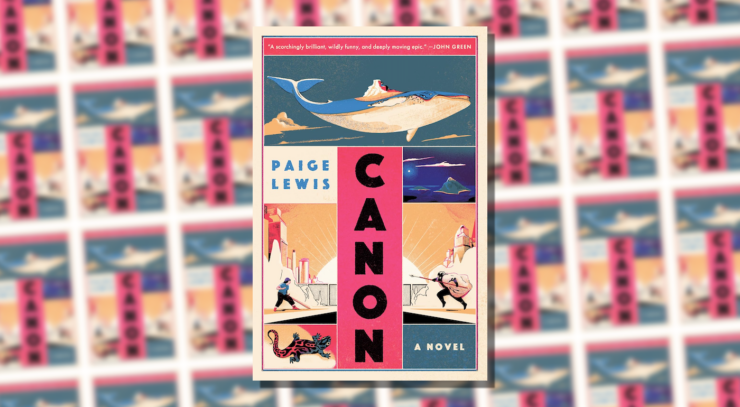
A disclaimer: No review is objective; this review will be less objective than most because I fear I have fallen in love with the author.
A second disclaimer: I decided to review this book for Reactor not only because I want to talk about it, but also because between the lie-detecting Newt, the delightful talking whale, the picaresque seafaring adventure, and the way Lewis swirls The Odyssey, the Hebrew Bible, and ’90s pop culture into a blender, I think this book falls under the umbrella of specfic.
I read most of this book in one sitting, at an old school Manhattan diner, where my near constant hoots and guffaws drew startled looks from the other diners. I mention this here at the top because a lot of what I have to say about this book will focus on its emotional arcs, but I also want to stress that Canon is often deeply, deeply funny.
Canon is Paige Lewis’ first novel. They’ve published a poetry collection, Space Struck, and co-edited another, Another Last Call: Poems on Addiction and Deliverance with Kaveh Akbar, and Canon reads like a book written by a poet. The language is precise and sharp, the imagery often startling in a way that makes you giggle while you read. Their word choices and connections make the book sing—and sing is really the correct way to describe it. Canon is an epic, in conversation with epics of old, and it asks what an “epic” can even be in 2026. What worlds are left to conquer? Should we want to conquer anything anymore? There’s no use singing of arms and men; we all already know the ending. Even arms and women—we’ve had decades of “Strong Female Characters” and it hasn’t gotten us anywhere interesting.
Instead Lewis sings us a song of the absurdity of arms, and the non-binary. They’re looking at what happens when war becomes indistinguishable from slapstick. When the hero doesn’t fit into the role of “man” or “woman”, is neither particularly strong nor possessed of Odyssean cunning, but has to figure out a way through their quest nonetheless.
In the opening pages, God asks Yara to go on a quest. They agree, but they’re not doing it out of devotion to God. They’re doing it because they need something from Him. Like a lot of queer people, they’ve been backed into a corner. They know who they are and who they love, but their parents react like they’re vermin that has to be chased out of the house before it can be clean again. They’re forced into a precarious living situation, and their life isn’t really their own; when God shows up and ask them to go on a mission to defeat a general named Dominic, they see it as a chance to get their life back.
Here I’ll quietly say the thing I always say when people bring God up: Never take the first offer.
However, I’m not a character in this book, so Yara has a quest to accomplish! As they set off on a picaresque journey transformed into a kind of mythic training montage, they gather companions including Newt, a newt, and a giant CAPSLOCK whale, who is not called “Whale” but instead, delightfully, HOWBIG!, and he was not sent as punishment from God, but rather provided by God as transport.
The whale is himself, though, and he makes his own choices that create a conversation with God-sent whales past.
HOWBIG! will most likely stand as my favorite character of 2026.
Yara’s story intertwines with the person who actually wanted the quest, God’s only female Prophet, Adrena. Adrena has two great uncanny talents. One I won’t talk about to avoid spoilers, but the other is “her ability to give excellent religious advice.” This comes about because she’s capable of direct communication with God. Or rather it might be better to say she can’t avoid direct communication with God: “Whenever God’s voice wasn’t actively inside her, Adrena’s head filled with static. It was as if God had forgotten to hang up His receiver and Adrena had no means by which to hang up hers.” Pissed off at God’s apparent favoring of Yara, she appoints herself the task of assisting General Harpo and his army of Good Guys in their battle against General Dominic and his army of Bad Guys. (If this sounds a little twee, I will rush to assure you that it doesn’t read that way on the page.)
This is an epic, and there is a battle. Lewis walks an interesting tightrope here. To a certain extent, the battle is a send-up of epic battles. It’s so absurd to watch an army that calls themselves The Good Guys fight an army that calls themselves The Bad Guys. They applied for a permit to fight on this field of glory. There’s a suburban neighborhood and a mall—apparently unaffected—a short walk away. And yet, when people die they really die. There is real pain, real blood, real gore. People die as people usually die: terrified, calling for their mothers, begging for just one more moment of life. And the giant external battle mirrors Yara’s struggle with their identity, their compulsions, and the terrible break with their family.
Lewis gives nearly every character time and space to become real people. People who seem like momentary comic relief are revealed to have layers. People who seem to be antagonists have their own dreams and origin stories that are every bit as important as Yara’s and Adrena’s. I think in the entire book only one person is left as a flat Bad Guy, and there’s a reason for that, too.
But again, and I cannot stress this enough: This book is funny as hell.
Buy the Book

Canon
Allow me to present a series of context-free quotes to underline my point:
Why not at least give it a shot? Yara thought. The worst God could say was no.
Well, really the worst God could do was send Yara to Hell with peeled eyelids so they could never look away from the horrors, which were likely customized for each individual soul.
When He looked into her eyes, she felt an almost holy embarrassment, like an angel with a nightgown stuck halfway over its head.
Who’s protecting me now? Used to be that whenever darkness fell onto the world, it missed me. I was Buster Keaton and God was the window.
While Canon is what we in the industry call “a chonker,” Lewis has written it as a series of short vignettes. Practically speaking, this means that the book’s action flies along. But that’s not the real strength here. The short sections act almost like comics panels, and draw a frame around the heart of each section. Lewis sidesteps all the stuff that can bog an epic down. We’re not watching characters walk for miles every day, or listening to sword genealogies or family trees, or hearing the same story told again and again. Instead, the structure breaks the story into facets and lets you look at each one in turn.
The narrator talks directly to us, the Readers, in their chapter headings. So we get titles like “Back to Yara and Their Problems” and “Let’s Fast-Forward Past the Boring Parts” and “Let’s Turn Away From That Unpleasantness for Now” and “I Know you Don’t Want This to Happen, but It Did”. Sometimes these titles function as jokes, sometimes as gut-punches, sometimes as a counterpoint to underscore whatever the section is about. It effectively makes the Storyteller another character, and serves to add even more speed to the narrative, as we hop from Storyteller to Yara to Adrena to Harpo to, occasionally, God Himself, giving the book a mood of popcorn prayer or exquisite corpse. But it becomes clear, as we’re carried on this journey, that Lewis is building a very intricate story and making it look easy.
To get a little more thematic, one of the quickest ways a book or film can win my heart is by acknowledging its own pop cultural context—but balancing that knowledge with genuine emotion and vulnerability.
There used to be a debate about high and low culture. About whether literary fiction should keep references to TV shows and cellphones at bay, lest they “date” themselves—as though Jane Austen and James Joyce aren’t “dated” now, and anything I write won’t be “dated” 10 years from now. An obsession with vernacular language. I remember whole David Foster Wallace interviews where the man had to justify his use of the word “like,” beginning sentences with “and” or “but,” and including references to ‘80s and ‘90s pop culture in his fiction.
Personally, I like knowing that a work respects my intelligence enough to say “Yes, of course, we’ve all seen The Simpsons, we’ve read The Odyssey in school, we’ve been to the mall, we’ve been in a record shop.” Since this book is kind of, slightly, vaguely set in a version of the ‘90s, one of the ways it captures that decade’s spirit is that “high” and “low” are jumbled together like videocassettes in a sale bin at a closing Blockbuster. There are references including but not limited to: Janus, Keanu Reeves, Jonah, Søren Kierkegaard, Jean-Luc Godard, the Lotus Eaters, Mitch Hedberg, The Simpsons, Tori Amos, and the soundtrack to Independence Day. Britney Spears and Orpheus appear on facing pages.
On the one hand, Lewis explores the way young people, maybe especially young people who have to make it on their own from an early age, tend to collect references and stuff to build a personality from the outside in. Yara wants to be a person who understands Kierkegaard, so pretends to read Fear and Trembling in public. (It’s possible I did this, or something similar.) Adrena’s a little older, but has stacks of half-read books on crafting, gardening, ukulele songbooks, etc., all because she wants very much to be a person who can do the things in those books. The references to books, TV shows, art, and movies add to their efforts to create selves in relationship to culture.
But on a bigger, more thematic level, the references become a commentary on the story Lewis is telling us. When Adrena and Harpo sally forth to the local mall for battle supplies, they go to Sears, a nut kiosk, a skin care kiosk, into a Waldenbooks and a Camelot Music that’s hosting an in-store show/album signing. The journey to and through the mall becomes a sort of riff on The Odyssey as each of these stores has its own wonders and dangers. In the Sears: “… the home section felt like what Adrena imagined Purgatory to be—cluttered and vacant.” In the Camelot: a Siren of sorts. The trip to the mall becomes epic in the way that trips to the mall did feel epic when you were a kid. Every day life was rich and textured and important. But also Lewis takes the concept of war itself and makes it as stupid and meaningless as it actually is—or should be—by acting like buying the right soundtrack might stave off disaster.
At the same time, these references are scattered around like glitter. You don’t need to notice any of them for the book to work. You don’t need to have seen Speed or read The Aeneid (though you should, if you have time, they’re both great) because Canon is telling its own stories—and one of those stories is about the anxiety of creating original art in a world teeming with stories you could simply reference instead. Yara’s artistic passion is embroidery, but so far they’ve only done renditions of paintings and photographs that already exist, some for practice or love, some on commission to make rent, but they never break out the needle and thread to create something new. Intermittently, tangled up in their worries about their quest, and God, and their estranged parents, they worry that they’re not good enough to be an “original” artist.
Meanwhile, Adrena can’t keep a girlfriend, doubts their own prophetic motivation, and, tangled up in their obsession with proving themself to God and worrying that they might not be able to help Harpo win his war, they worry that their terrible gift for destruction might, well, destroy everything they’re trying to build.
Finally, given the nature of this story, I supposed I should talk briefly about God.
I mentioned up top that Adrena hears messages from God without a real way to tune them out. One of the fun details is that God tends to show up in Adrena’s head when she’s giving head; He shows no qualms about appointing a non-binary person to be His great champion. Lewis shows us, repeatedly, that queerness is a non-issue for this book’s God. But beyond that? Things tends to get unwieldy once God gets involved: How much of a theological rabbit hole do you want? Are you co-signing one particular religion, or a vague syncretism? Is God objectively real in your book’s world, and if so, do they live up to any of the rumors we’ve heard about them in this one?
Lewis threads all these needles with assurance. Their version of God makes sense for their universe, while also remaining fundamentally unknowable—a good quality in God. This is a human story about humans, and while Lewis gives God some fun set pieces, and asks some pretty dark questions about them at times, they never let Him take the story away from Yara and Adrena.
There’s a lot of depth lurking beneath the rollicking waves of this book. Lewis uses a fun structure to explore loneliness and queerness and different types of love, all woven into a story of the futility of war, the question of whether people can ever return home once they’ve left, what we owe to each other, and whether it’s ever safe to turn your back on God. I love the world Lewis creates, and I loved following their characters on an epic quest for truth and meaning.
Canon is published by Viking.